Monday Advice from Agents and Editors: Don’t Make Janet Reid Cry

Sorry to be posting a day late.

Janet Reid is a very successful literary agent with FinePrint Literary Management who offers great advice to aspiring writers. Her blog has (at last count) 266 blog entries under the key words “query pitfalls.”

On May 14, 2014, Reid addressed the issue of how to begin your email query. What should you put first? According to Reid—and every other agent I’ve checked in with

THE VERY FIRST THING

…should NOT be

  • The agent’s name, place of business, address, or any of the other bits of information that used to be standard back in the dinosaur age of FORMAL, MAILED queries. This is 2014, people!
  • Your own name, address, phone number, email addy, or any other information about how to locate you, should an agent be enthralled by your query. Hint: You emailed them. They can just REPLY to your email!! Innovative, isn’t it?

No, in Reid’s words, the very first thing in your query should be the “most enticing” fact you can possibly give about your book.

HOW TO ENTICE

Unfortunately, the richly detailed setting, the distressing background of a main character, and the historical milieu aren’t going to do it. None of these will entice Janet Reid. What will catch her attention and make her read more is

“the compelling conundrum your protagonist is facing.”

That’s it. She wants to know right up front, in the first sentence if possible, what urgent conflict makes the book interesting enough to read.

In the FAQs on her website, Reid directs writers to queryshark.blogspot.com for sample queries and suggested revisions. Many other agents recommend QueryShark, too. Some actually critique submitted queries on their websites/blogs. And all give the same advice about skipping the header and putting the good stuff first.

Crying about queriesAnd yet, Reid claims in her recent post that she got at least a dozen queries in one day that started out with someone’s address. She wails, “The seas will soon be too salty with my tears of woe if this keeps up.”

Don’t make Janet Reid cry. According to climatologists, we’ve already got a rising sea level problem.

Posted in Advice, Agent, Janet Reid, Queries | Leave a comment

Monday Advice from Agents and Editors: Start with Character

susan_hawkIn a recent post for Adventures in YA Publishing, Susan Hawk of The Bent Agency answered the burning question, “What would make you stop reading when reviewing sample pages?”

Her answer wasn’t specifically directed to YA manuscripts. But it was surprising—at first glance. She’d prefer that writers NOT jump straight into action.

What?!?!?

No Action?

Actually, Hawk agrees with every writing coach in the world that you shouldn’t put a lot of exposition and description in your opening pages. That means no beautiful prose about sunsets or any scene-setting that goes on for more than a couple of paragraphs. No backstory info-dumps. No looking in a mirror and thinking about your character’s appearance. But we all know that.

What Hawk says she prefers, right away, is Character.

“What a character wants tells me something about them and gives me [a] connection. Often, I see opening pages that jump into action, before establishing character. Without that, it’s hard to be very invested in action and pages can feel like a bunch of stage directions.”

It’s hard to argue with that. Watching a woman make eye contact with a gorgeous man isn’t as interesting as watching your best friend—who just got fired and lost her apartment—avoid trading looks with the hunky guy who’s staring at her. Even watching a perfect stranger run screaming down the street isn’t the same thing as watching your next-door neighbor—who’s often shown you the marks of abuse from her lover—run from her house, terrified and bleeding.

Telling us what your character wants out of life, and why, might help—but that would be… Telling. So how do you give your reader a connection to your character without a lot of exposition and description?

Umm, with action? But… but… she said…

The Right Kind of Action

Relax. What Hawk doesn’t like is jumping into story-based action. That’s the kind where your main character is plunged on page one into The Plot. Right away, a shot rings out or a car crashes or the doctor says, “Make the most of the time you have left.”

Blake Snyder (Save the Cat!), Christopher Vogler (The Writers Journey), and James Scott Bell (Write Your Novel from the Middle) all agree with Hawk.

Vogler says to begin in the character’s “ordinary world.” Snyder wants an opening that reveals the character before any change takes place. Bell advises hints about the character’s pre-story psychology. They all want the focus to start with Character instead of what happens to the character.

As Hawk explains further, “Give the reader enough background to care [what happens].”

Examples of character-based action:

  • Show a kind person being kind, and paying a price for it.
  • Show an abused person trying to hide the signs of abuse.
  • Show a lonely person eating alone at a crowded wedding reception.
  • Show a bitter person reacting to someone else’s success.

And then you can bring on your Catalyst. Your Inciting Event. Your Call to Action. Your Story.

Posted in Character-driven action, Character-driven action, Openings, Susan Hawk, Uncategorized | Tagged , , | 1 Comment

Monday Advice from Editors and Agents: The Golden Triangle of Plotting

Every Sunday James Scott Bell blogs about writing on The Kill Zone or TKZ. But he’s not just reminiscing about his “journey” or killzone-banner (2)his favorite writing retreat. Bell (bestselling, award-winning author, writing coach and fiction columnist for Writer’s Digest magazine) is handing out FREE advice about how to write.

His recent post, A New Approach for Plotters, Pantsers, and Everyone in Between, gives writers a fresh new way to look at sagging middles.

A New Look at Midpoints

Last July, Bell blogged about The Magical Midpoint Moment. After watching scores of movies, he realized that their midpoints were not as much externally-driven PLOT points as much as they were internal CHARACTER points—places where the main character reflects on what’s gone before and what’s likely to (or must) happen next. He felt these reflection points were like mirrors inserted into the story.

Bell’s Next Step: The Golden Triangle

He incorporated this idea into his craft workshops and began to flesh it out as a way for both plotters and pantsers to look at developing stories. He now calls his theory “writing from the middle” and of course, there’s a new book about how it works.*

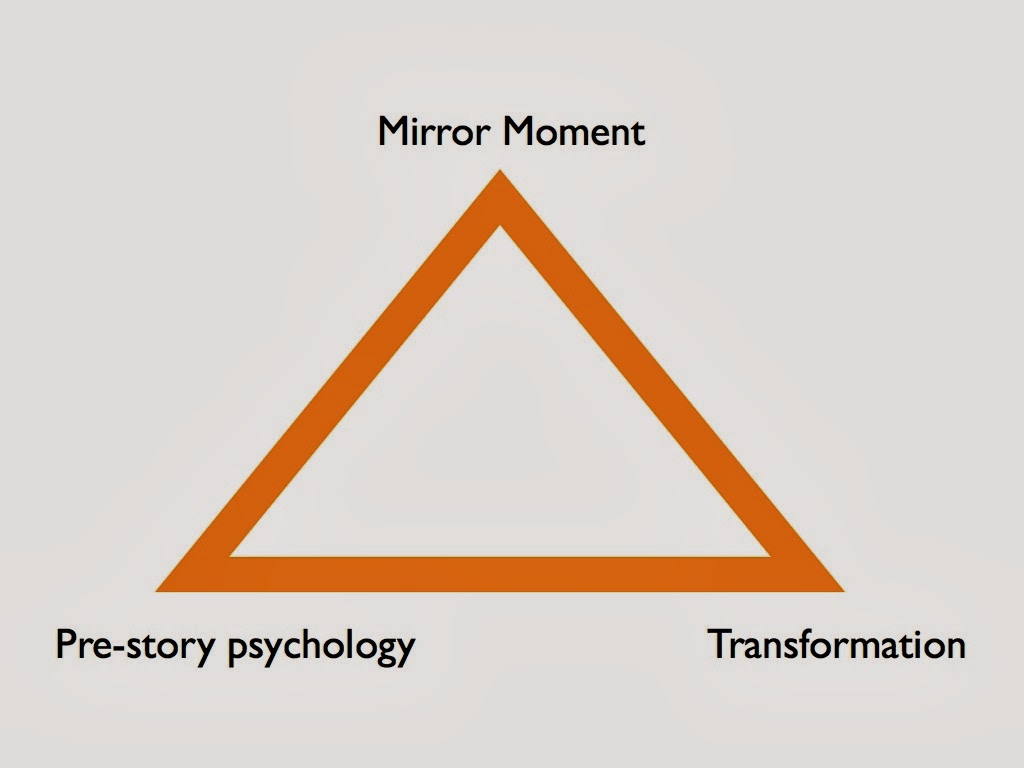
Golden Triangle Three PointsThere’s also a great visual: The Golden Triangle

I think Bell’s illustration is crystal clear. The focus of the story should be on what’s in the character’s makeup/past that gets him or her all the way from the inciting incident to the reflection midpoint—and then what changes to the character’s makeup must happen to make the ending possible.

This character-focused way of looking at building story makes a lot of sense to me. How about you?

james-scott-bell-300Besides writing award-winning legal thrillers (both human and zombie), books about vigilante nuns(!), historical romance(!), and short fiction, James Scott Bell is the bestselling author of Plot & Structure, Revision & Self-Editing, The Art of War for Writers and Conflict & Suspense. He blogs weekly at The Kill Zone (TKZ). And, while he’s not technically an editor, Bell is one of the reviewers for TKZ’s really useful—and FREE—First Page Critiques.

*Bell’s new book about the golden triangle and writing from the midpoint is Write Your Novel from the Middle: A New Approach for Plotters, Pantsers and Everyone in Between. Click on the title to learn more about it.

Posted in Uncategorized | Leave a comment

The Best Writing Advice

John_ScalziJohn Scalzi is a Film Critic/Columnist, Writer/Editor, Freelance writer, Novelist (his own words). He’s a New York Times best seller in fiction and has won the Hugo, the Locus, the Seiun and Kurd Lasswitz awards. His works have been translated into 20 languages. He’s been a Creative Consultant for the Stargate: Universe television series and was president (7/10 – 6/13) of the Science Fiction and Fantasy Writers of America.

Yesterday, Scalzi asked readers of his blog, Whatever, What’s some good advice you’ve gotten on the craft of writing?The answers are terrific! It’s like a complete course in creative writing, but in small, easy-to-remember bursts. Lots and lots of quotable moments here.

So check it out HERE and add your own comments.


Posted in Advice, Craft of Writing, Uncategorized | Tagged , , , , , , , , , , | Leave a comment

Monday Advice from Editors and Agents: Use [Only] the Right Words

Marilyn Brigham has a popular workshop she’s presented at writers’ conferences. It’s called, The Editor’s Eye: Powerful Word Choice & Sentence Structure. Repetition and Clutter are two of her main topics. Liz Pelletier has put together an intensive novel editing challenge called Editpalooza for Savvy Authors. Several of her assignments focus on word choices, including one Pelletier has named, “Search and Destroy.”

delete buttonAre you seeing a pattern? If it hasn’t hit you over the head yet, perhaps these two quotes from Samuel Clemens (otherwise known as Mark Twain) will make their point clear.

To get the right word in the right place is a rare achievement. To condense the diffused light of a page of thought into the luminous flash of a single sentence, is worthy to rank as a prize composition just by itself. . . . Anybody can have ideas–the difficulty is to express them without squandering a quire of paper on an idea that ought to be reduced to one glittering paragraph. Mark Twain (Letter to Emeline Beach, February 1868)

I notice that you use plain, simple language, short words and brief sentences. That is the way to write English–it is the modern way and the best way. Stick to it; don’t let fluff and flowers and verbosity creep in. When you catch an adjective, kill it. No, I don’t mean utterly, but kill most of them–then the rest will be valuable. They weaken when they are close together. They give strength when they are wide apart. An adjective habit, or a wordy, diffuse, flowery habit, once fastened upon a person, is as hard to get rid of as any other vice.” Mark Twain (Letter to D. W. Bowser, March 1880)

TAKE OUT ALL THE FLUFF

First, both editors advise writers to take out all redundancies. What is that? Usually it’s a totally unnecessary adverb (notice my subtle deletion).

Using a strong verb will often eliminate the need for an adverb. Examples:

  •  The radio blared loudly in the next room.
  •  Mary whined annoyingly about every exercise.
  •  Trent crept quietly into the room.

Often, the verb implies what the adverb says, again making the adverb totally unnecessary.

  •  Penelope raced quickly down the stairs.
  •  The sparrow flew up to the ceiling.

Chopping blockNext, take out all those “emphasis” words you overuse. Don’t think you’re guilty of this one? Try searching your manuscript for the words very, really, only and just. Of course, these words are often overused in everyday dialogue and if that’s where you’re putting them, leave a few for character identification. But if they are showing up in description and narrative, kill ‘em.

Now work on your dialogue and see how many tags are unnecessary. If you can tell by the word choices, diction or accent who is talking in a lengthy exchange, you don’t need tags. And if your characters are hissing, spitting, grumbling, chuckling, or laughing their lines, you really need to make them stop it! (Hint: try actually hissing the words Get Out. Can’t be done.)

Finally, check paragraphs (and whole pages) to see whether you have used the same specific noun, adjective or verb more than once. Pronouns and articles don’t count. What does count: Your heroine thinks that George is being unfair and complains to Pam that he unfairly took her words out of context, then winds up railing at the unfairness of it all.

LEAVE IN THE GLITTER

For this, you have to actually have some glitter. Most of us do. But sometimes it’s obscured by a hedge of dull prose.

To get at the glitter, make sure you’ve taken out as many “weak” words as you can. The list includes:

suddenly
that
of course
felt
heard
wondered
thought
decided
saw
looked

These words are not strong; they don’t convey an image to the reader. Look for better, golden words, or look for another way to frame the sentence that involves action.

The thesaurus has a lot of shiny words. Definitely use it, but sparingly. Remember Twain’s advice about plain, simple language. When all the fluff that covers your language is gone, your ordinary words will shine through.

Angry, Frustrated WomanA BELIEVER’S TALE

After my agent submitted my Middle Grade fantasy to several editors, I received several very complimentary rejections. The consistent complaint was that my manuscript was too long. Over the last four months, I pared my 76,000-word manuscript down to 52,000! That was 24,000 unnecessary words. My agent cheered and hopefully so will the editors. How did I do it? I just told you how. Now go forth and edit!  –Donna

Marilyn Brigham is an editor for Two Lions and Skyscape. She has been working in the children’s books field for the past nine years, first at Marshall Cavendish Children’s Books and now at Amazon Children’s Publishing. For more on her word choice workshop, see http://rickischultz.wordpress.com/2011/03/29/pointers-from-the-pros-editor-marilyn-brigham-offers-insight-into-the-editors-eye/ and http://tabwriter.blogspot.com/2010/11/crafting-powerful-sentences.html

Liz Pelletier is co-founder of Entangled Publishing and Savvy Media Services, which owns Savvy Authors. In addition to running a successful publishing house, Liz teaches courses on editing, query writing, and contract negotiations. For more about Savvy Authors (writers helping writers), check out http://ce.savvyauthors.com/index.cfm. For information on Editpalooza, see https://ce.savvyauthors.com/index.cfm?fuseaction=Calendar.eventDetail&eventId=2109


 

Posted in Editing, Taking out fluff, Uncategorized | Tagged , , , , , , | 10 Comments