
Teen Tuesday: Scholastic Art & Writing Awards

scholastic_awards_logo_rgb_DSThe Scholastic Art and Writing Awards program was established by Maurice Robinson, founder of Scholastic Books, Inc.  Since 1923, it has been the largest and most prestigious recognition program and source of scholarships for creative teens in the U.S.

How the competition works

Regional sponsors across the U.S. administer the competition and awards each year. In the fall, student work from school districts and individual schools (including private schools) compete at the regional level in 29 categories of art and writing. Student entries are judged by panels of highly-qualified professionals who select Gold Key, Silver Key and Honorable Mention recipients. Gold Key winners go on to compete at the national level. More than 1,500 students receive national awards each year.

Luminaries who have served as judges include Langston Hughes, Robert Frost, Judy Blume, Billy Collins, Paul Giamatti, Francine Prose, Edwidge Danticat, David Sedaris, Lesley Stahl, Nikki Giovanni, Roz Chast, Wangechi Mutu, Andres Serrano, Kiki Smith, Jill Kraus, Shinique Smith, Rashid Johnson, and Waris Ahluwalia.

Past winners include Andy Warhol, Sylvia Plath, Truman Capote, Richard Avedon, Robert Redford and Joyce Carol Oates.

Regional winners are being announced now. From these, a designated number of best-in-region selections will be judged nationally for American Voices/American Visions Medals. Winners (both artists and writers) will be named as national medalists this spring. Many students will gain the opportunity to attend ceremonies in Carnegie Hall in New York City where Scholastic Art & Writing is located.

Regional winners in Texas announced

In Harris County (Houston, Texas) teen recipients of awards hail from 18 Harris County school districts, 16 private schools, two charter schools and a home school. A total of 8,177 entries were submitted—2,100 writing and 6,077 art. Of the 2,100 writing entries (including 33 portfolios), awards consist of 124 Gold Key, 172 Silver Key and 302 honorable mentions. For the 6,077 art entries (including 324 portfolios), awards consist of 252 Gold Key, 352 Silver Key and 506 honorable mention.

2016 Awards information (and new scholarships!)

Luxury retailer Neiman Marcus will offer two new awards this year: the Neiman Marcus Award for Fashion and the Neiman Marcus Award for Jewelry! Works in the fashion and jewelry categories will automatically be eligible for consideration. The Heart of Neiman Marcus Foundation will offer two scholarships of $1,000 to one Gold Medal recipient in fashion and one in jewelry.

Note there is a new category in the Awards this year: Editorial Cartoon sponsored by The Herb Block Foundation. This category will judge submissions of drawings, illustrations, comic art, and animations with a political theme or message.

Visit the artandwriting.org website to explore all of the Scholastic Sponsored Awards and sign up for the artandwriting blog here.
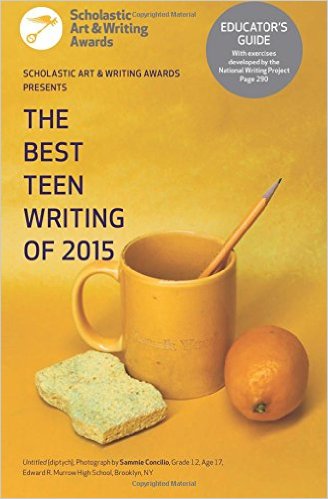
best teen writing of 2015See samples of last year’s winners in The Best Teen Writing of 2015, published in August, 2015. It showcases stories, essays and poetry by teen authors who earned a National Medal in the Scholastic Art & Writing Awards during the 2014-15 competition. (An Educator Guide is included.)
 

Posted in Awards, Books, Contest, Scholastic Art and Writing Awards, Teen Authors, Teen writers, Tips for Teen Writers, Writing | Tagged , , , , | Leave a comment

Monday Advice from Editors and Agents: Know Mako Mori and Bechdel?

mako mori and bechdelDo you know Mako Mori and Bechdel? No, they’re not hot new publishing houses, or editors, or authors. They are standards/tests meant to rate the gender inclusiveness of a book or film–and some agents are starting to mention them in wish lists.

BECHDEL TEST

The Bechdel Test is very simple. It asks whether a work of fiction

  • features at least two women
  • who talk to each other
  • about something other than a man.

It all started with a cartoonist, Alison Bechdel, her friend Liz Wallace, and these words from Virginia Woolf in A Room of One’s Own:

All these relationships between women, I thought, rapidly recalling the splendid gallery of fictitious women, are too simple. […] And I tried to remember any case in the course of my reading where two women are represented as friends. […] They are now and then mothers and daughters. But almost without exception they are shown in their relation to men. It was strange to think that all the great women of fiction were, until Jane Austen‘s day, not only seen by the other sex, but seen only in relation to the other sex. [emphasis is mine]

Once the test idea was proposed, discussions popped up all over social media and news outlets. Some critics added that the women must have names.

Starting in 2013, some European movie and cable TV companies began to incorporate the Bechdel test into their submission guidelines. Similar tests were suggested, including the Finkbeiner Test for journalists and the Sphynx Test for theatre scripts.

MAKO MORI TEST

The Mako Mori Test goes a step further, analyzing whether a movie has

  • at least one female character
  • who gets her own narrative (story) arc
  • that is not about supporting a man’s story.

WHY ARE THESE TESTS IMPORTANT?

The practical aim of both Bechdel and Mako Mori is to ensure the presence of fully fleshed-out, “realized” female characters who contribute significantly to the story, thereby drawing in a larger audience of women to the work [my take]. (And no…. Movies, such as Name of the Rose, which takes place in an all-male monastery, do not have to pass these tests!)

I’ve seen an increasing number of agents mention one or both of these tests when discussing what they’d like to see in fiction submissions. Laura Zats croppedJust today, I read an interview with Laura Zats of Red Sofa Literary, a boutique agency with clients all over the world. Zats is very particular. Reacting to a glut of certain plotlines, she outlines what she DOESN’T want in Young Adult fiction (no paranormal romance, dystopia, or Chosen One stories). For Middle Grade, she is “looking for books that are heavy with STEM and will appeal to girls and boys.” In traditionally male-dominated Science Fiction and Fantasy, Zats says submissions “Must pass either the Mako Mori or Bechdel tests.” Overall, she includes “diversity (in all forms)” among her criteria. And she’s not alone in this.

WHY ARE THESE TESTS IMPORTANT FOR ROMANCE NOVELS?

I think most feminists would agree that creating strong women characters and gaining a larger female audience are not the only goals of such tests. Writing strong, fully developed female and male characters just makes for good storytelling.

Everyone knows that manuscripts with stereotype characters for the romantic male lead won’t make it out of the slush pile. One way to flesh out that male character is to give him a chance to demonstrate his personality, show off his professional skillset, reveal his softer side, or unleash his anger in scenes with other characters–particularly other men. Even that old standby plot, Two Strangers Trapped by a Snowstorm/Hurricane/etc., relies on the addition of offscreen cast members to flesh out the troubled pasts of the main characters.

Showing how a person acts and interacts with his/her own gender can reveal information that is harder to portray in man/woman interactions. Male buddies (and female best friends) talk freely about things they have to be pushed to discuss with the opposite sex. They enjoy a different level of intimacy from what lovers do. They often enjoy different activities and entertainment, too.

The trick here is to reverse the criteria for the two tests when writing a novel with a female Main Character. Ask whether your manuscript

  • features at least two men
  • who talk to each other
  • about something other than a woman.

And/or whether the story has

  • at least one male character
  • who gets his own narrative arc
  • that is not about supporting the woman’s story.

Use these opposite criteria to create stronger male protagonists in romance stories.


Posted in #mswl, Agents, Character, Character arcs, Character-driven action, Characters, Craft of Writing, Differentiating Characters, Differentiating Characters, POV - Point of View, Story Elements, Writing | Tagged , , , , , , , | Leave a comment

Teen Tuesday: 15-year-old author’s success story

EMILY croppedEmily Trunko, a high school sophomore who studies from home, has been the subject of articles in newspapers across the world and is now under contract to write two books.

My name’s Emily, and I’m 15.  —Emily

She started her publishing journey as the author of two widely-read and hugely popular Tumblr blogs, Dear My Blank and The Last Message Received. Last Message was ranked Number 8 among Tumblr’s most viral in 2015.

I’ve always been interested in people’s lives and their stories.  —Emily

When someone asked if she’d turned her subject matter into a book… Emily decided to try. She queried a select group of agents… and within two hours she had an contract with the Bent Agency. Within three days, Random House asked her for books based on both blogs. 

Emily’s success is unusual… but not impossible to believe. She achieved her goals through hard work, the same butt-in-chair work every author has to do. You don’t monitor and promote a blog with more than 80,000 followers by sitting on your duff and watching TV all night.

And Emily is a resourceful, enterprising person.

When she was 10 she discovered that publishers sent copies of their books to reviewers, so she started a book review website, On Emily’s Bookshelf, as a way to get free books. —Mary Beth Breckenridge (Akron Beacon Journal)
She’s also smart. Instead of blindly slinging her idea out to the universe, she used Google to research and find the agents she wanted to query.

Emily’s books aren’t out there yet. But I’ll be standing in line to get them. And I’m betting she’s got a lot more great ideas just waiting to burst out. I can’t wait to hear what they are.

What ideas do you have that you could turn into gold– into books, or blogs, or apps, or videos? Or into the next new thing on the horizon?

Read more about Emily here


Posted in Authors, Social Media, Submission, Teen Authors, Teen writers, Tips for Teen Writers, Writing | Tagged , , | 2 Comments

2016 Pitch Contest Calendar

Be sure you click on the continuation link to read more in this post from John Berkowitz. There is a calendar list of twitter pitch contests that will be really useful if you have a completed manuscript!

John R. Berkowitz's avatarAm I Doing This Right?

142090425

Okay, kids – get your Twitter pitches, 35-word pitches, queries, and first 250 words shined up and ready.  Here’s a breakdown of the pitch contests coming up in 2016.

If you’re new to the concept, these are contests for authors with complete, polished manuscripts who are seeking representation by an agent and/or an editor.  These contests are fierce and popular, and the competition is strong and numerous.  But there are several advantages to entering:

1) Putting yourself out there. If you’re new to querying and not sure how to begin, or nervous about exposing your work to strangers, this is a good way to dip your toe in the raging whitewaters of the publishing world.

2) Getting feedback on your presentation.  Theses contests are all about those fiddly bits you use as bait to lure an agent or editor.  It is assumed your book is already finished, edited, beta’d, revised…

View original post 1,141 more words

Posted in Writing | Leave a comment

Teen Tuesday: 2015’s “Best Of” Book Lists for Teens and Young Adults

It’s the time of year when everyone tallies up their favorite books of the previous twelve months and publishes a Best Of list. Here are links to seventeen of the top reading lists for Teens and Young Adults.

Publishers Weekly’s Best Children’s Books of 2015: This list includes books for infants to teens.

BuzzFeed Books. The 16 best Young Adult books from 2015.

YALSA (Young Adult Library Services Association) 2015 Best Fiction for Young Adults. Picked by members of the American Library Association.

The 2015 National Book Award for Young People’s Literature: One award-winning medalist and the runners-up.

ALA (American Library Association) Includes John Newbery Medal for most outstanding contribution to children’s literature; the Michael L Prinz Award for excellence in literature written for young adults; Alex Awards for the 10 best adult books that appeal to teen audiences; Pura Belpre Award for best Latino writer; and more. Winner and runners up.

The New York Times’s Notable Children’s Books of 2015: A selection from the newspaper’s children’s books editor.

Amazon Best Books of 2015. Amazon ranks its top best-sellers.

The Horn Book’s Fanfare: The editors’ picks for best children’s and young adult books of the year.

School Library Journal: A real biggie: The SLJ review editors’ picks for the year’s best titles across books, apps, audiobooks and more.

Goodreads Choice Awards 2015: Based on a total of 3,007,748 votes from readers.

The Guardian’s best children’s books of 2015: Selected from books published in the U.K.

Quill and Quire‘s 2015 kids’ books of the year. Selected by the books for young people’s editor of this Canadian magazine.

The Boston Globe’s best books of 2015.

The Wall Street Journal‘s Best Children’s Books of 2015.

The Washington Post’s best children’s books of 2015: The Post’s reviewers share their picks in fiction, nonfiction, and picture books.

The Fort Worth, Texas Star-Telegram. A best-of list for young book lovers, selected by the staff.

HAISLN (Houston Area Independent Schools Library Network) 2015 lists published by grade level. A new list will be published in March, 2016.

For a few more “Best Of” book lists, check out this article from Publishers Weekly.

Posted in Awards, Books, Reading, Recommendation lists, YA Book lists, YALSA top picks, Young Adult books | Tagged , , , , | Leave a comment