Backstory: Putting your world in context

Context: the set of circumstances or facts that surround a particular event, situation, etc.

Context can give us clues to the meaning of an unfamiliar word, the emotion behind a friend’s reaction, the point of a political slogan.

  • The word “flag” can call several images to mind. But even if we’ve never used it this way ourselves, we can sense the meaning through context of a sentence like, “My energy level flags at the end of the day.”
  • When everyone else cheers for someone’s successful stage debut, you completely understand the context of your friend’s tears –her best friend wannabe-actress just died of leukemia.
  • Without context, you might be confused by a cartoon I saw recently that put a Stephen King byline on “The Path to Prosperity” (the congressional budget).

World-building, or context, makes a plot richer, characters more complex, and setting more accessible. It makes the fictional story world believable.

three friendsCommon sources for story context

  • Your characters’ backgrounds (backstory that often explains motivations and desires)
  • Their social setting (friends or the lack of them, marriage, courtship, and the activities associated with sustaining relationships)
  • The work/school part of their lives (jobs, classes, employers, coworkers, competitors, worry/anxiety)
  • The sociopolitical milieu (what’s happening in the world, near and far, that impacts your characters)

How to use these sources to create rich story context

Look around you, this very minute. Is there a photo of a family member or friend visible? Do you love or hate the room you’re in? Do you enjoy/fear/anticipate/loathe the activity you are supposed to be doing right now? Are you comfortable, hot, or cold? Is the lighting too bright or too dim? Have you just learned that people you know are in danger somewhere in the world? Are you ill or in pain? Have you just won the lottery or learned you’re pregnant?

Sad Teenage GirlThis is your immediate context, the background that gives meaning to the next thing you do or say. Now you absolutely don’t want to write a scene in which the reader knows the answer to every one of those questions, but you do want the reader to know enough to understand the emotional and physical state you are in when you say or do that next thing.

A main character who gets surly after a couple of drinks and pours a beer on another man U.S. Soldier Dressed in Camouflage Angrily Shouting Commandsat a bar, may be assumed to be uncouth, a drunk, or a bully. But a main character who is fearful and anxious about being sent off to fight a war is understandably unsympathetic to a bar patron who complains his beer isn’t cold enough. How do you “show” the character’s fear and anxiety so the reader isn’t turned off by the character’s scorn? You reveal the context of the immediate situation. Look around the character; look around his world. Is he wearing fatigues? Does he fidget with dogtags? Is he glued to a TV in the bar showing scenes of the war? Does he have three empty bottles in front of him already? Does he fail to notice someone bump into him, or call his name? Does he drum on the table incessantly?

Take this same care to reveal context whenever you want your reader to understand a character’s actions. You don’t always have to use description, though. Conversation and interior thoughts can be just as revealing. Does the guy at the bar mutter curses at what he sees on the TV? Does he answer abruptly, or with a grunt, when someone asks if he’s in the army? While he watches the screen, is he thinking about his fiancée? Is he remembering a friend who returned home with only one leg?

Many writers who are just learning the craft will create detailed biographies of their characters, and then write a story that doesn’t use any of that material. Others cram pages of backstory into their early chapters, slowing the story down to a crawl. Character backgrounds are invaluable sources of context, helping readers understand the actions/reactions of characters. But an info-dump isn’t entertaining. Ease into context by leaving clues. Not too many, just enough.

How to ease into context

Mentioning, once, that a character’s bedroom is lined with shelves of shabby, second-hand books speaks volumes (no pun intended) about the character’s intellectual life and economic status. You don’t have to beat the subject to death by having the character wish they could afford new bestsellers, and gaze longingly in the window of a bookstore, and sigh about the lack of money for luxuries… dribbling the context into chapter after chapter. If you provide the context, and then always have the character act consistently within that context, your reader will understand the motivations that arise from it.
knightHistorical context requires a bit more frequent maintenance. The reader needs to stay firmly in the period, so most scenes will need to have some reminder of the milieu. This could be as simple as a phrase that period-specific, a description of a hairdo or ornament, a reference to a familiar person living during that time, or a social custom. But you don’t want to slow the pace of the story with lengthy descriptions of room contents, architecture, or obscure language. If the hero is fighting the villain, a quick sentence about ripping off a cravat might do to remind the reader he shouldn’t expect a modern forensics team to clean up the scene.

Fantasy and science fiction share a common perception that their worlds are “made up.” But within the context of both, the world needs to have Fantasy eyeconsistency and familiarity. Creating worlds in which nothing is familiar will slow down the reader who has to adapt to every single new thing. Again, look around your “made up” world and really see it, feel it, taste and smell it. What is the same? What is almost the same? What has the same function but a different name, and what has the same name but an enhanced function? You can ground (pun intended this time) a weightless or flying scene by having a familiar stationary landscape, or characters who are as clumsy in the air as they are on the ground, or a feeling of nausea that is similar to what a character experienced after eating bad fish. The reader who can identify with part of the scene can be carried along to the unfamiliar parts.

Posted in Backstory, Backstory | 2 Comments

Monday Advice from Agents and Editors: Kill all the darling, puffy babies!

In his 1914 Cambridge lecture “On the Art of Writing,” Arthur Quiller-Couch said,

hatchet     “If you here require a practical rule of me, I will present you with this: ‘Whenever you feel an impulse to perpetrate a piece of exceptionally fine writing… delete it before sending your manuscript to press. Murder your darlings.’”

In the 100 years since that lecture, his advice has been attributed to or repeated by such writers as Oscar Wilde, Eudora Welty, G. K. Chesterton, Chekov and Hemingway. Even Stephen King, who was once told his writing was “puffy,” passed on the same advice in his {completely, totally wonderful} book “On Writing”—

     “…kill your darlings, kill your darlings, even when it breaks your egocentric little scribbler’s heart, kill your darlings.”

OUCH! THAT’S HARSH

A magazine editor offered to edit Jonathan Goldstein’s WIP. But, to Jonathan’s dismay, X in circlethe pages came back with huge Xs on pretty much every page.

But here’s the important thing: the editor, Ken Sparling, didn’t hate Jonathan’s writing.

     “…what I saw in the best of his writing spoke to me in a powerful way. What I heard behind the best of [his] words was a beautiful innocence, an earnestness that shone through Jonathan’s intelligence, his well-developed sense of irony, and his cleverness. At his best, Jonathan was able to preserve this earnestness in the face of his own cleverness. At his best, he was able to rein in his cleverness and use it in the service of his earnestness.”

Somehow, Jonathan was able to process the well-meaning hit and use it effectively.

     “Seeing a big “X” through my most sincere and, what I thought, most beautiful thoughts, was one of the greatest learning experiences ever bestowed on me.”

In Jonathan’s words, “It was a lesson in… ‘killing your babies.’”

APPLYING THE TOURNIQUET

Yes, such harsh editing hurts like stitches on an open wound. But if you follow the diagnosis and prescription, you can heal a broken WIP.

On the blog site Canada Writes, Camilla Gibb recounts the toughest thing an editor ever told her and its effect on her writing. First the comment made about a particular chapter in Camilla’s manuscript:

     “It’s not the reader’s job to indulge you, Camilla…. gratuitous, fatty passages overstuff a manuscript. Better to isolate the tastiest bits than drown them all with gravy.”

Camilla says she had enjoyed writing that chapter more than any other. But she took the criticism to heart. She now trims the fat and throws away ninety per cent of what she writes, distilling her manuscript down to its essence.

She is now the author of four novels and has received the Trillium Book Award, the City of Toronto Book Award and the CBC Short Story Prize, AND has been shortlisted for the Giller Prize.

I think it worked.

Now pardon me while I cry for five more minutes over the Xs on my own WIP and then go kill some babies. A lot of babies.

Posted in Editing, Taking out fluff | Tagged , , | 2 Comments

Monday Advice from Agents and Editors: The Truth about Gatekeepers

mnike_underwood_200x250-150x150Mike Underwood is with Angry Robot Books, a British publisher of some pretty fantastic science fiction and fantasy. In a recent post, Mike addressed some “secrets” of the publishing industry that every aspiring author should know.

Now it’s no real secret that literary agents act as Gatekeepers, or that publishing houses employ people whose sole function is Gatekeeping. Every author knows about these soul-less villains who automatically reject our precious work, adding computer-generated best wishes for getting through a gateway somewhere else.

But Mike maintains that the job of a Gatekeeper is not to keep people out, but to let people in. (Do I detect a little skepticism in my readers? Read on anyway, please.)

THE GATEWAY

No Trespassing gateThe problem seems to be with numbers. Hundreds if not thousands of potentially great books on one side of the gate and perhaps only a dozen actually published books on the other. On the face of it, someone is doing a pretty good job of not letting books through.

Underwood begs us to look at it another way. “The editors aren’t keeping you out, they’re looking for the right publishing partners to fulfill their own business and creative agenda.” What does that mean? In publishing-speak, it means that editors are looking for “a mix of genres, a mix of debuts and more established names, a mix of more commercial and more adventurous titles, in order to keep their imprint’s list viable.”

In other words, if the house already has several debut authors slotted for the next 18 months, they’re going to be reluctant to look at another debut—no matter how good it might be. Say the slot that’s standing wide open, the one they really really want to fill, is for a big name author who’s starting a new series. Only if they give up hope will they send someone else to that reserved table.

How can you fight that? The easy answer is you don’t. You find a publisher whose Gatekeeper is holding open an empty slot with your name on it. (More on that, later.)

The same advice holds for agents. According to Underwood (and common sense), “Most can only reasonably support a few dozen clients, since they’re going to be doing a bunch of different things for their clients, from chasing down royalty payments to selling books to negotiating contracts to helping with publicity to working on selling sub-rights.” It would be nothing short of miraculous if one of the most famous, well-established agents had an open spot with your name on it. You need to look somewhere else. You need to look for a Gatekeeper agent who’s looking for you.

WHAT’S A WRITER TO DO?

Even seasoned authors occasionally need to look for a new agent or new publisher. They know the key to getting through the Gate lies in being realistic.

If you’re looking for an agent, try the newest one at each agency that’s right for you. They’re hungry to build their stable of clients and willing to look at unpublished authors.

If you’ve been rejected by the major publishers, try the midsize and small (legitimate) ones, especially if your book falls into a “niche” that a smaller press is known for (such as funny science fiction, teen horror, cozy mystery, chick lit romance, etc.)

  • The Big Five: Penguin Random House, Simon & Schuster, HarperCollins Publishers, Macmillian U.S., Hachette Book Group
  • The Midsize Publishers: Harlequin, Kensington, John Wiley & Sons, Inc., W.W. Norton & Company, Hyperion, The Perseus Books Group
  • Small Presses: too numerous to mention!

GET GOOD GATE INFORMATION

I write for young adults. One of the newsletters I subscribe to is Adventures in Children’s Publishing. This outstanding newsletter frequently spotlights a new agent who is looking for exactly what I write.

I also subscribe to the FREE edition of Publishers Marketplace: Publishers Lunch. After the announcements of new contract deals (a good source for who’s buying what), there is publishing news. Here’s where you can find out about new imprints at a publishing house and who the primary editor will be; agents who’ve moved to a different house; and even editors who’ve decided to go into the agency business. These announcements are very timely—you can be the first to know about a new agency or new publishing house.

Another excellent source of agent information is WritersDigest.com’s New Agency Alerts.

chinese gateAnd finally, there is QueryTracker, a site I’ve mentioned before. Here you can find writer-reported information on agents and editors, their track records, affiliations, and so much more.

Using these and other good sources of information, you can OPEN YOUR OWN GATE!

Posted in Finding agents, Finding publishers, Gatekeepers, Publishing Industry | Tagged , , , , | Leave a comment

Monday Advice from Agents and Editors: What We’re Looking For TODAY

Here are two opportunities to find out what agents and editors are looking for right this minute. Really. You don’t have to guess any more, you don’t have to waste your time sending in that 150,000-word dystopian-Regency vampire-werewolf romance you just finished. You can check out these wish lists and see just exactly what the market is looking for.

agentandeditorwishlist.tumblr.com

The first site was set up as an archive but has evolved into an active resource. It’s on tumblr.com, a popular social media site whose members share an eclectic mix of stuff: music, videos, photos, graphics and text. Travel to agentandeditorwishlist.tumblr.com and you’ll find a chronological listing of agent/editor wishes.

Some are vague but interesting:

“Heists, Pirates, Spies,” from Victoria Marini (@litagentmarini)

Some are a lot more specific:

“Any type of project that can successfully remind me of a Miyazaki movie. Strange, fantastical, vivid, quirky characters,” from Hali Baumstein (@halibaumstein)

or

“Give me anything with Hasidic or Orthodox Jewish characters either memoirs or fiction MG/YA/NA/Adult,” from Rena Bunder Rossner (@renarossner)

And sometimes you’ll get several who all want the same thing:

“The speculative version of the TV show Leverage. YA or adult.

Many, but not all of these wishes come from one source…

#MSWL on twitter

Every six months or so, agent/editor wishes start pouring in to an online event with this twitter hashtag.

Susan Hawk at the Bent Agency recapped the highlights of the #mswl event last February on her agency blog. From time to time, agents and editors still continue to drop in with posts.

But the good news is this fantastic event will begin again September 3, on twitter, at the hashtag #mswl. It’s lots of fun to watch the wish-tweets come in, one by one, in real time. And be sure to keep checking back to see what new wishes are added during the year.

More twitter hashtags you might find useful are #askagent, #tenqueries and #amwriting.

Note: #MSWL is not a pitch event. If you think your manuscript is exactly what someone says they are looking for, go ahead and send a short message directly to the requester. But do not pitch, especially not that dystopian-Regency vampire-werewolf romance.

Posted in #mswl, Uncategorized | Leave a comment

Urgent: Deadline for Teen Travel Essay

I just discovered this incredible essay contest for teens, but the DEADLINE IS JULY 27!!! The Family Travel Forum and the Society of American Travel Writers want to know,

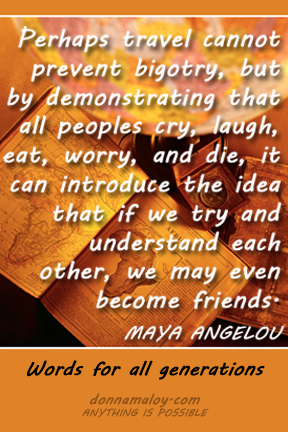
Maya Angelou on travelDo you have fun travel stories to share?

“Have you ever taken an unexpectedly wonderful — or terrible but funny — trip with your family?  Or have you journeyed somewhere with a school group or sports team and have some advice on how to make the most of your experience or destination?  Have you gone somewhere — near of far — that opened up new ways of looking at the world?”

Your essay can be serious, funny or thoughtful. Just get it down on paper and get it in to this contest right away!

Cash! Awards!

Top winners get cash awards. Twenty-five finalists win honorable mention awards and travel gifts such as passes to Ripley’s Believe It or Not! attractions. Ten finalists win a pair of CityPASS ticket booklets containing prepaid admission to the top attractions in their choice of 10 North American destinations: New York City, Atlanta, Boston, Chicago, Hollywood, Houston, Philadelphia, San Francisco, Seattle or Toronto.

There’s a How-To video, list of rules, and FAQs on the Family Travel Forum website. Don’t put it off–remember, the deadline is JULY 27!! PASS IT ON.

Bonus: the contest website also has a terrific video on how to write a great college essay.

Posted in Contest, Teen Travel Writing, Uncategorized | Tagged , | Leave a comment